

P40 Monoblock Valve for Small Mobile Machines
Time : Oct 29, 2026 View : 42
The P40 monoblock valve is a 40 L/min model of the KYDAC P series of monoblock valves. The P40 is a single cast iron block valve, rated for 250 bar, which can be produced with 1 up to 7 working sections. It is suitable for use on compact machines, for example forklifts, sweepers, waste disposal units, sprinkler systems and small load handling machines with pumps delivering up to 40 L/min.
Two numbers define a valve. The first number defines how much oil a given pump can deliver. The second number defines how many functions a given machine has. A lift, tilt and sideshift forklift has 3 sections, a brush, compactor and water sweeper has 3 sections also. Check the circuit type, spool function, ports and pressure before ordering.
What the P40 Monoblock Valve Handles
Flow is the headline number. The P40 hydraulic valve is rated at 40 L/min nominal flow, about 10.6 US GPM. Maximum working pressure is 250 bar, about 3626 psi. The body is cast iron, and the valve can be ordered with 1 to 7 working sections.
This valve can operate at working temperatures from -40°C up to +80°C and with oil viscosities between 12 cSt and 400 cSt. Choose an oil grade which is within these limits at the temperatures that your machine will be operated at. This will cover cold winter starts and hot summer operation.
Pressure is a ceiling, not a target. In other words the 250 bar maximum working pressure of a valve is only relevant for certain applications. Choose the valve on the basis of the application and then let the relief protect the relevant part of the system at the appropriate pressure.
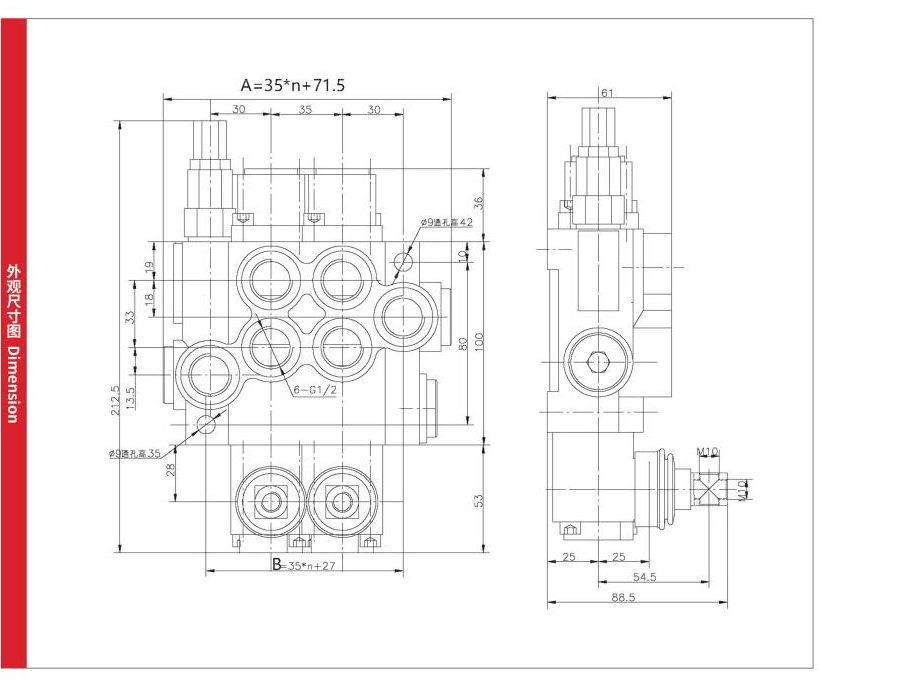
The section count of a block also determines its size. The KYDAC dimension drawing shows the sections on a 35 mm center line. Each additional function increases the width and weight of the valve body. Only count the functions that you really use. A four-section valve for a two-function machine only adds excess cost to the valve.
When 40 L/min Starts to Matter
Flow picks the body. A pump delivering approximately 40 L/min will not need a larger casting than P40. A 40 L/min hydraulic valve is sufficient for these applications. These are typical applications for forklifts, ride-on sweepers, garbage trucks, aerial work platforms and small loaders. A sweeper for example will operate brush, compactor and water valve circuits and will typically require less than 40 L/min.
Step up a size when the pump gives more. Above about 40 L/min the P40 starts to restrict flow, and the P80 or P120 carries it better. Cylinder size matters too: a larger-bore cylinder needs more oil to reach the same speed, so check the cylinders as well as the pump.
A bigger valve is not going to increase flow. A P120 will not increase the flow delivered by the pump; it just provides more valve flow capacity and usually costs more. Choose a valve of suitable size for the pump and not the nameplate capacity.
The speed of the cylinder is dependent upon the flow from the pump divided by the piston area. Therefore, even with the correct valve, a large bore cylinder on a small pump will extend slowly. You must compare the bore of the cylinder to the pump output prior to blaming the valve.
P40 Next to the P80 and P120
The sizes are closely related. The valves are cast iron monoblock type, 250 bar rated with 1 to 7 sections. The main difference between the three sizes is the rated flow.
Model | Nominal flow | Max working pressure | Sections | Typical machine |
|---|---|---|---|---|
P40 | 40 L/min | 250 bar | 1 to 7 | Forklifts, sweepers, small loaders |
P80 | 80 L/min | 250 bar | 1 to 7 | Tractors, front loaders |
P120 | 120 L/min | 250 bar | 1 to 7 | Large tractors, harvesters |
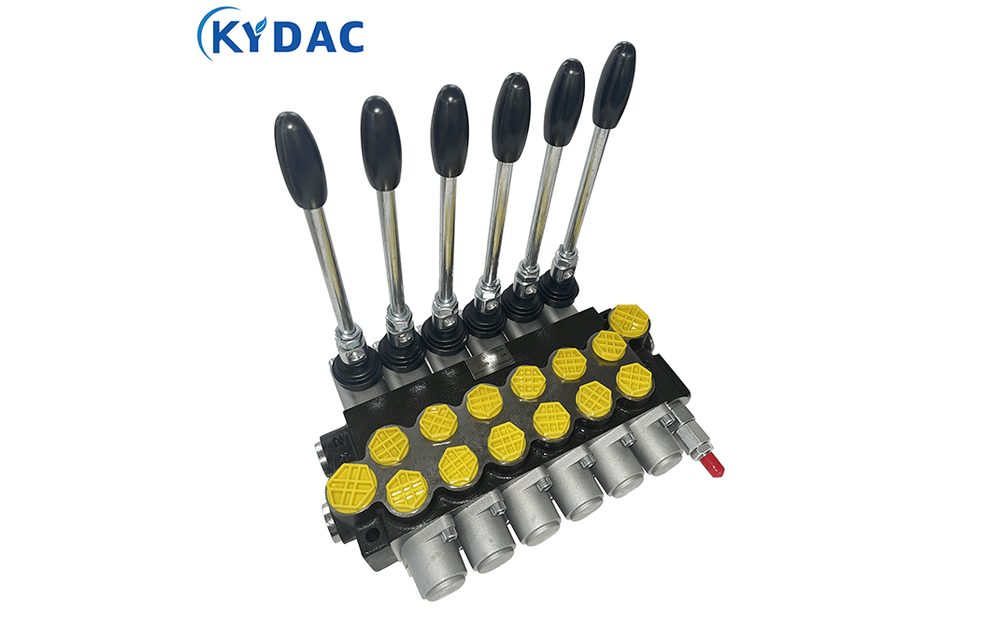
The P40 is recommended for applications with system flow below 40 L/min and a very compact design. The P80 is recommended for tractors and front end loaders with 80 L/min or less capacity while the P120 is suited for larger tractors and harvesters with higher capacity. The KYDAC P series hydraulic valves range comprises these three sizes.
Monoblock Build and Field Behavior
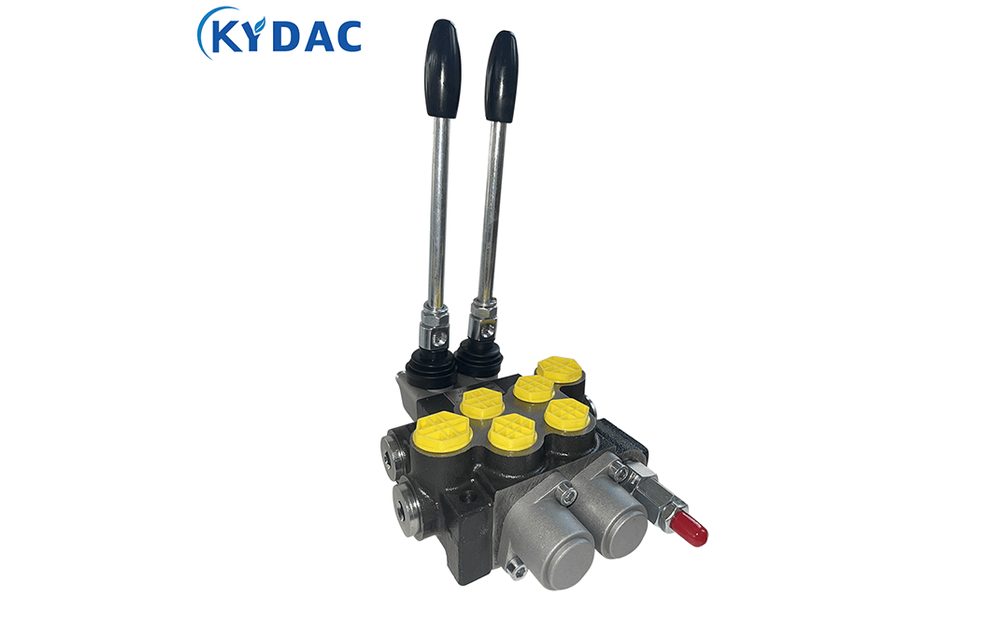
A monoblock valve is a single cast iron casting which includes the spool bores and passages. All these are machined into a single block as against being bolted together in separate sections. Thus, on a machine that vibrates all day, there is one less place for an external leak to start.
Cast iron also absorbs shock in cycling of spools under full pressure, shift after shift. The rigid body of cast iron maintains alignment of bores and mating surfaces. This alignment is critical to maintaining leak-tightness of spools within the valve body.
KYDAC grinds the spools to a precise fit in the bores to limit internal bypass. The trade-off of a monoblock build: sections cannot be added later. If the machine is likely to gain functions, a sectional valve is the safer choice.
Keep the oil clean and the valve will generally have a longer service life. Problems like stuck or drifting spools can often be traced back to dirty oil. A relief setting that has been turned down too far can also cause insufficient system pressure. Remember to change the oil and filter on a regular basis and set the relief using a gauge rather than relying on ‘feel’.
Sizing and Replacement Notes
Two numbers start the selection: pump flow and function count. Flow picks the body, whether P40, P80, or P120. Function count sets the sections: lift, tilt, sideshift, brush, and each rear remote usually take one spool. Then verify circuit type, spool function, ports, and control method. For larger multi-circuit work, KYDAC also builds sectional and other directional control valve designs.
Many compact machines are equipped with monoblock valves. Although the KYDAC P40 is offered as a same-spec part for these applications, it is not a drop-in part and must be checked against the machine’s drawing for port position and thread, mounting dimensions, circuit type, spool function and pressure.
Conclusion
Flow picks the body. A forklift, sweeper, or small loader pumping 40 L/min or less gets clean, responsive control from the P40 monoblock valve at the lowest cost in the P series. It carries 1 to 7 sections at 250 bar, is rated for working temperatures from -40°C to +80°C, and runs on 12 to 400 cSt oil. When a circuit needs more than 40 L/min, step up to the P80 or P120; when it needs more than 120 L/min, the KYDAC DCV series covers the heavy end.
FAQ
Q: Which machines suit a P40 monoblock valve?
A variety of machines fall into the compact category, such as forklifts, sweepers, trash trucks, sprinkler trucks, aerial work platforms, and small skid-steer loaders. These typically run with pumps that deliver less than 40 L/min. A typical forklift hydraulic valve stack is organized in to three sections for lift, tilt, and sideshift functions. If your system runs frequently at greater than 40 L/min, then the P80 or P120 body would be more suitable.
Q: Can the P40 replace an imported monoblock valve?
It may be a same-spec replacement, but not necessarily a direct replacement. Verify port locations, thread sizes, mounting dimensions, circuit type, spool function, and working pressure against the original part’s engineering drawing before ordering.
Q: How many sections can the P40 carry?
1 to 7 working sections. The number of sections relates to the number of functions that the machine can perform, such as lift, tilt, sideshift, brush etc as well as a compactor. A monoblock body cannot be re-stacked after delivery so order the correct number of sections from the outset.
Q: What warranty and quality standard back the P40?
KYDAC will build the P40 under its ISO/TS16949 quality system. The unit will come with a 2-year warranty. Sampling, lead time and OEM/ODM options will be confirmed against your detailed specification.
Leave a Message
If you are interested in any product, please contact us. We will introduce our products to you in more detail


